


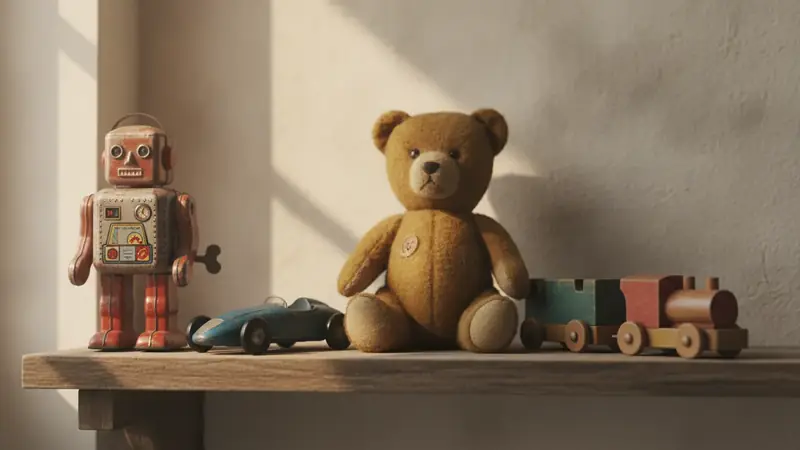
What actually identifies a toy
A character's face tells you the franchise, and that is about all. Dozens of makers have released the same character over the decades, so the identity of a specific toy sits in the small stamped and printed marks. Here are the ones that separate one toy from another.
| Clue | Where to look | What it tells you |
|---|---|---|
| Maker name and copyright year | Underside, back of the neck, soles of the feet, car chassis | Who made it; the year is often the mold or license date, not the retail release |
| Series or wave | Box front, back panel, card header, sticker | Which line it belongs to and who else is in the lineup |
| Set number | Box, instruction manual cover, bag labels | The exact building set, and what parts should be inside |
| Accessories | Box inset, manual, back-of-pack photo | Whether it is complete or a mixed lot |
| Packaging style | Card design, window shape, logos, barcode | Region and rough era; whether it was ever opened |
| Tag or tush label | Seam of a plush toy or doll | Maker, material and sometimes production details |
A year stamped on a die-cast car or a vinyl figure often points to when the mold was cut. The toy itself may have come out later, sometimes much later, in new colors. Treat the stamped year as a clue to the mold, then let the series and packaging narrow the release.
How to photograph a toy so it matches well
Put the toy on a plain surface in daylight and shoot the whole thing, front first. Then turn it over. The underside is where the maker and copyright year usually live, so that photo does as much work as the front one.
- Take a full front shot with nothing else in the frame.
- Take a second photo of the stamped text, close enough to read.
- For fashion dolls, show the face print and hair as well as the body markings, since the head and body may carry different stamps.
- For boxed toys, photograph the front panel; if you are using a barcode, scan that instead.
- For building sets, shoot the set number on the box or the cover of the manual.
You can also add a short text hint, such as "die-cast car" or "vinyl figure", to focus the search. Loose accessories confuse matching, so keep them out of the main shot and photograph them separately if they matter.
What Price ID returns for a toy
Pick the Toys & Collectibles finder, then snap a photo, choose a saved image or screenshot, or scan a barcode. Price ID tries to name the toy, including brand and model when it can recognize them, and lists matching listings with direct store links.
Buying prices for new copies come from online stores, with the lowest price found for your shopping region. For used toys you get an estimated resale range with a typical price and example listings. Those figures come from current used-item asking prices on eBay, which is not the same as what buyers finally paid. Anyone asking how much is this toy worth should read the range as a market ceiling to test, not a promise.
On iPhone, a toy value app is easy to keep at hand for the toy aisle or a garage sale table; the iOS app is listed as "What's It Worth: Price Scanner" on the App Store. Rental, monthly-plan and junk listings are filtered out, so the results are mostly real toys for sale.
Toys that come back as close cousins
Toys are full of near twins. A reissue can share a mold with the original and differ only in paint, packaging or a safety line on the box. A plain, unbranded figure may only get similar matches, because nothing on it says who made it. Prices, availability and matches vary, so confirm the details with the seller before you pay.
- Same mold, different release: compare the series and packaging text.
- Dolls with swapped outfits or heads: the match may fit the body but not the clothes.
- Sets with a missing minifigure or part: the match is the complete set, and yours is not.
- Custom or bootleg pieces: a photo can look right while the plastic, paint and stamps are off.
Price ID does not authenticate toys or appraise them. If a rare piece is on the line, get a collector to hold it.
How much is this doll or toy worth?
Value swings on condition more than on the name. A boxed toy with an intact card or sealed bag usually sits well above the same toy loose. Complete beats missing parts by a wide margin, and for dolls, original clothes, shoes and tiny accessories count. People asking how much is this doll worth, or how much is this barbie worth, are often looking at a doll that lost its shoes years ago.
Run the same photo for a die-cast car and you have a quick hot wheels value app check; do it for vinyl figures and it works as a funko pop value app check too. Look for scuffs on the card, yellowed plastic, loose joints and cracked boxes, and compare against listings in the same condition.
Checks before you buy or list a toy
Before you hand over cash, flip the toy and read the stamp yourself, then compare it to the match. Count the pieces against the box or manual. If it is a building set, count against the parts list.
Sellers should photograph the underside and every accessory, and say plainly what is missing. If you want to flip items for profit, price from the used range instead of the new price, and allow for the fact that asking prices run higher than what actually sells. Save promising finds into a collection and set a reminder to re-check the price later.
Sorting through a box of mixed toys is a different job from a single item. When you are not even sure what item is this, run the broad finder first and the toy finder second. At a thrift store, a thrift finder habit of scanning the toy shelf pays off because bagged lots are rarely labeled. Records and books have their own checks, and a vinyl record value app is better for that bin.
On Android, the first scan is free, then you get one free scan a day, with more by watching a short video. Used as a collectible value app there, Price ID is listed as "Price ID: What is This Worth?" on Google Play, and you can share an image straight in from another app.
Quick questions
What are Labubu dolls?
Labubu dolls are collectible vinyl and plush figures of a toothy, pointy-eared monster character designed by artist Kasing Lung. They are sold by Pop Mart, often in blind boxes, which is why many collectors hunt for specific editions.
What toy is hot now?
Hot toys shift quickly, but recent crazes have centered on blind-box collectibles, trading cards and plush characters. Checking current listings and sold items on resale sites shows what buyers are actually chasing at the moment.
What's the newest toy craze?
The newest craze is usually a collectible that sells out fast, such as a limited blind-box figure or a trading card set. Crazes tend to fade within months, so prices for the hottest items can swing sharply.
What is a misfit toy?
A misfit toy is a toy with an odd flaw or quirk that makes it different from others, made famous by the Island of Misfit Toys in the 1964 TV special Rudolph the Red-Nosed Reindeer. The idea is that each toy is unwanted for a quirk but still deserves a home.
What toys are shown in Toy Story?
The main toys in Toy Story are Woody, Buzz Lightyear, Mr. Potato Head, Slinky Dog, Rex, Hamm, Bo Peep and the Etch A Sketch. Many of these are real toys, so older originals from the 1940s to 1990s can be collectible.
How can I tell how old a toy is?
Look for a copyright year and maker name stamped on the back, base or underside, then compare the materials and packaging style to known releases. The stamped year is often the year of the original design, so the actual production date can be later.