


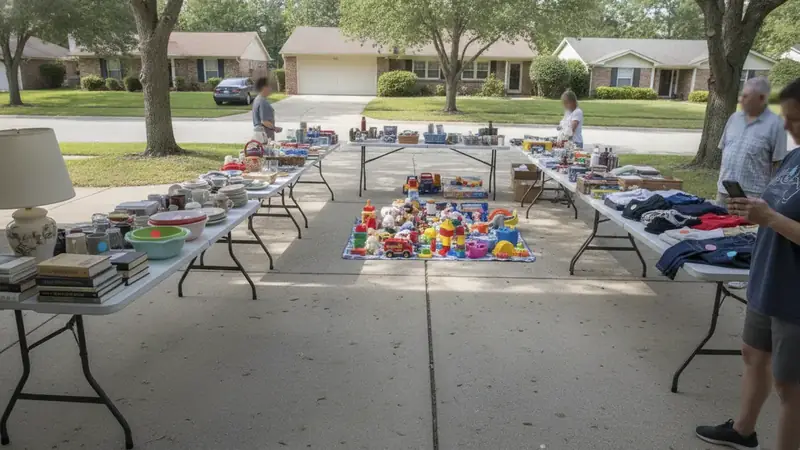
The short answer on how to price garage sale items
The common rule of thumb is that used goods at a garage sale go for a fraction of retail, often somewhere around 10 to 30 percent. Those ranges are a rule of thumb, not data, so adjust them for your neighborhood, the season and how fast you want everything gone.
Shoppers arrive expecting bargains, and most of your table will sell at a price that feels almost silly. That's fine. The goal is an empty driveway by two o'clock, with a handful of items priced higher because you checked them first.
Garage sale prices by item type
| Item type | Typical share of new price | Notes |
|---|---|---|
| Clothes | Low end, about 10 percent or less | Price by the piece; kids' clothes go even cheaper in bags |
| Books | A dollar or less each | Paperbacks lowest; clean hardcovers a little more |
| Kitchenware | 10 to 20 percent | Sets and small appliances in good shape go higher |
| Furniture | 20 to 30 percent | Solid wood and clean upholstery hold value best |
| Tools | 20 to 30 percent | Working power tools with their battery or cord |
| Toys | 10 to 20 percent | Complete sets beat loose pieces |
| Electronics | 10 to 30 percent | Test it on the spot; newer models go higher |
| Decor | 10 to 20 percent | Frames, vases and candles move fast when cheap |
| Collectibles | Check before pricing | The one row where the rule of thumb can fail badly |
How to read the chart
Start from the new price, not what you paid. If a blender costs about forty dollars new today and yours is clean and works, the 10 to 20 percent range puts it at four to eight dollars. Dusty, missing a lid or from a discontinued line? Drop to the low end.
Round to easy numbers. Fifty cents, one dollar, two, five. Odd prices slow down the line while buyers dig for change, and you'll spend the morning making change instead of talking to people.
Condition moves you inside a range more than anything else. Original box, all the parts and a working test outlet are worth a step up.
The few items worth pricing higher
In a typical house, most items are ordinary and a few are not. A brand-name tool, a game console, an old toy still in its set, a signed print, a retired kitchen mixer: these can be worth far more than the chart says, and they're the ones people regret underpricing.
Price ID is built for this check. Take a photo, pick a saved image or scan the barcode, add a short text hint if the item is plain, and it identifies the product and shows an estimated resale range for used items. On an iPhone, a garage sale app like Price ID is easy to keep open on the table while you sort. On Android, a yard sale app works the same way, and you can share a photo straight to Price ID from another app.
The resale range comes from current used-item asking prices on eBay. Asking prices run above what shoppers pay on a driveway, so don't copy the number onto a sticker. Use it as a ceiling, then price below it, often at a half or a third, depending on how quickly you want it gone. Condition, model and included accessories change value, and plain or unbranded items may only get similar matches.
Checking tools, toys and collectibles first
Ask yourself how much is this tool worth before it goes in the cheap bin; a quick scan of the model plate or the tool itself can settle it. The same goes for toys and collectibles, where a specific edition or complete set separates a one-dollar item from a forty-dollar one.
If you want to know how to find out what something is worth for free, start with the free scans Price ID gives you and spend them on the odd items, not the stack of paperbacks. The free tier is limited, so choose carefully. On iPhone you get a limited number of free scans daily; on Android the first scan is free, then one a day, with up to two extra by watching a short video.
Stickers, bundles and haggling
Put a price on everything, or group items under one sign (everything on this table, one dollar). Buyers skip unpriced things because asking feels awkward.
- Bundle small stuff: three mugs for two dollars, a bag of kids' clothes for five.
- Keep your top few items near the front so people see them early.
- Price slightly above your floor, since someone will haggle.
- After lunch, cut prices in half or move to a fill-a-bag deal.
Haggling is part of the day. Decide your lowest number for the bigger pieces beforehand so you aren't deciding under pressure from a buyer holding cash.
Selling elsewhere: when the garage sale is the wrong place
Some things are better kept off the driveway. If a scan shows a resale range far above anything a garage sale crowd will pay, set that item aside and ask how much is it worth to sell online instead. The same goes for the odd piece you'd normally pick up as thrift store scanner bait or among flea market finds: if it looks valuable, check before you tag it.
A good rule is that anything with a possible value worth shipping gets a scan; everything else follows the chart.
A Saturday morning, start to finish
It's the night before. You have six boxes and a folding table. You tag clothes at fifty cents, paperbacks at a dollar for three, mugs at a dollar each, and the lamp at five.
Then you find a heavy cordless drill with two batteries in the back of the garage. You scan it with Price ID, add the brand as a text hint, and the estimated used range is well above your usual tool price. You tag it at a number below that range, sensible for a driveway, and set it by the front of the table.
By ten o'clock the drill has a buyer who counters a few dollars lower. You've already decided your floor, so you say yes. At noon you slash everything on the table to half price and you're done by two.
Quick questions
How do you price furniture for a garage sale?
Price solid wood furniture at roughly 20 to 30 percent of its new cost, and particleboard pieces much lower. Clean, sturdy items like dressers and bookshelves sell fastest, so check for wobbles, stains and missing hardware before choosing a number.
What are normal garage sale prices?
Most used household goods sell for about 10 to 30 percent of the new price. Clothes, paperbacks and mugs usually go for a dollar or two, while working tools, clean electronics and sturdy furniture can reach higher.
What doesn't sell well at garage sales?
Used underwear, car seats, old textbooks, bulky tube TVs and heavily worn clothing rarely sell. Items with safety recalls or missing parts also tend to sit, so donate or recycle them instead of pricing them.
How do I know if something is worth more than garage sale prices?
Look up the brand and model on resale sites before you price anything that looks unusual, such as vintage toys, name-brand tools or older electronics. Price ID can scan a photo or barcode and show an estimated used-price range based on eBay asking prices, though those are estimates and not guaranteed sale prices.
How much should I sell clothes for at a garage sale?
Most used clothes go for a dollar or less each, and kids' clothes sell well in bags. Only a few pieces, such as clean name-brand items, are worth a higher tag.