


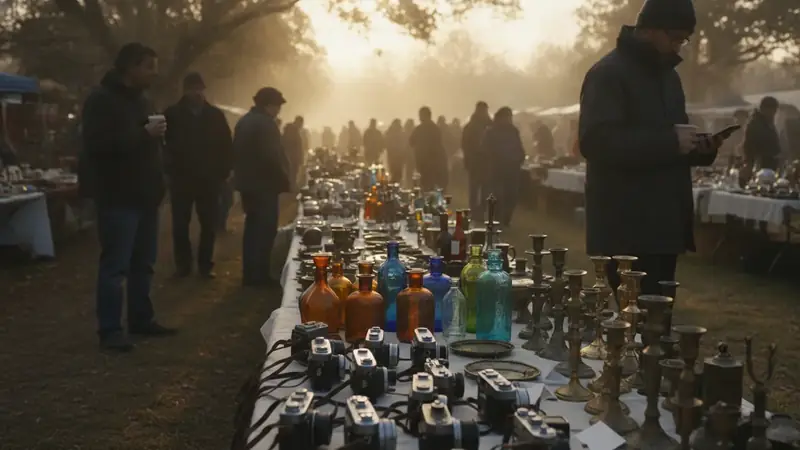
You arrive before the crowd
It's early, the vendors are still unloading, and the best boxes are not yet open to the public. Go anyway. Dealers and resellers show up at this hour, and anything underpriced tends to leave with them.
Bring small bills, a tote bag, a flashlight (dim tents hide chips and cracks), and a phone with a charged battery. Walk the whole row once without buying. You're mapping the market, not shopping yet.
You scan a table before you touch anything
Your eyes work faster than your hands. Look for heavy glassware, metal with a visible stamp, old tools, tins, framed art, and toys still in their packaging. Ignore the pile of mugs and the phone chargers.
Pick up one promising piece, then ask the seller where it came from. An answer like "an estate near here" tells you the rest of the box may be worth digging through. Estate sale finds often arrive this way, in lots, with the good pieces mixed among the ordinary ones.
You turn it over and read the marks
The bottom of an object tells you more than the front. Look for a maker's stamp, a country of origin, a pattern number, a hallmark on silver, or a signature scratched into pottery. Weight helps too: real sterling and solid brass feel heavier than plated or hollow lookalikes.
- Glass and ceramics: check rims and bases for chips and hairline cracks
- Metal: look for a stamp, and a magnet will tell you if steel hides under a coating
- Wood: dovetailed drawers and hand-cut joints point to older furniture
- Toys and collectibles: original box, missing parts, and fading all change value
Take a photo of the mark. You'll want it in a moment.
You check the value on your phone
This is the moment a flea market app earns its place in your pocket. On iPhone, Price ID is listed on the App Store as "What's It Worth: Price Scanner", and you can snap the object, pick a saved photo, or scan a barcode if there's one. Add a short text hint, such as "cast iron skillet" or "1970s tin lunchbox", to point the search at the right thing.
Price ID identifies the item with visual matches and shows an estimated resale range for used goods, with a typical price and example listings. That range comes from current used-item asking prices on eBay, not completed sales, so it tells you what sellers want, not what buyers paid. It is not an appraisal. Condition, model, and missing accessories can move the real number a lot, and plain or unbranded pieces may only return similar matches.
On Android, the thrift store scanner app version is called "Price ID: What is This Worth?" on Google Play. You can share a photo straight from another app into it. The first scan is free, then you get one free scan a day, and the free tier shows ads.
For a deeper reference on older pieces, an antique price guide is still useful at home, but at the table you want a quick range, not a chapter.
You haggle, politely, with cash
Now you know a rough range. Sellers expect a conversation, so have one. Ask, "What's your best price on this?" and then stop talking. The silence does a lot of the work.
If you're buying several things from one table, bundle them and offer one number. Cash helps; peeling bills out of your pocket is more persuasive than a request to split a payment. Never insult the piece by naming a lowball price loudly, and do not haggle over a few dollars on something that is clearly already cheap. If the seller won't move, you can walk away and circle back later. Sometimes they call after you.
You carry it home without breaking it
Wrap glass and ceramics in a sweater or newspaper before they go into the tote. Keep heavy items on the bottom, and keep small parts, like lids and screws, in a bag taped to the object. Do not clean anything yet. Scrubbing old paint, patina, or a maker's mark can lower the price.
You decide: keep it or resell it
At home, look at the saved scan again with better light. If the resale range is well above what you paid, after allowing for fees and shipping, it's a candidate to list. If the range is thin or the item is chipped, keep it, gift it, or pass.
You can save the find to a collection in Price ID and set a reminder to re-check the price later, which suits pieces you're not ready to sell. Selling at your own garage sale next? Knowing how to price items at a garage sale comes down to the same habit: check a range, then set a friendly number a bit under it. Resellers wanting a dedicated tool for the thrift side may also like a thrift scanner for racks and shelves, which works on the same principle.
Garage sale finds work like flea market finds, only the tables are lawns and the sellers rarely know what they have. Show up early, scan fast, bring cash.
What to repeat next time
- Arrive early and walk the whole row first.
- Pick up only what catches your eye, then flip it and read the marks.
- Photograph the mark and scan the item before you negotiate.
- Ask for a best price, offer a bundle, pay in cash.
- Wrap it well and leave it uncleaned.
- Compare the range to what you paid, then keep or list.
Quick questions
What to find in a flea market?
Flea markets are good for vintage glassware, pottery, tools, costume jewelry, vinyl records, old toys, cast iron cookware and small furniture. Items from brands or makers with a collector following, such as Pyrex, Fiesta ware or Fisher-Price, tend to hold the most value.
How to spot valuable items at thrift stores?
Flip each item over and look for maker marks, stamps, signatures and labels, since these often separate a $2 piece from a $200 one. Heavy weight, solid wood, sterling or 14k stamps, and made-in-USA or made-in-Japan marks on older goods are good signs. Check for chips, cracks and repairs before you pay.
What sells well at markets?
Items that are useful, affordable and easy to carry sell best, such as kitchenware, tools, plants, handmade goods, vintage clothing and collectibles. Priced-to-go small items usually move faster than large furniture, which needs a buyer with a truck.
What not to sell at a flea market?
Avoid selling recalled or unsafe items, such as drop-side cribs, car seats past expiration, and some old children's products. Counterfeit goods, items with lead paint concerns, and anything your local rules restrict, like certain food or weapons, are also best left out. Check your market's vendor rules and local laws before you set up.
What is the most sold item at a flea market?
There is no single official top seller, but clothing, jewelry, books, household goods and used tools are among the most common and consistently purchased categories. Low-priced items under about $20 tend to make up most individual sales because shoppers buy them on impulse.
How do I check flea market finds value on my phone?
Take a photo of the item or scan its barcode in Price ID, and add a short text hint if you like. The app returns an estimated resale range based on current used-item asking prices, which is an estimate and not an appraisal.