


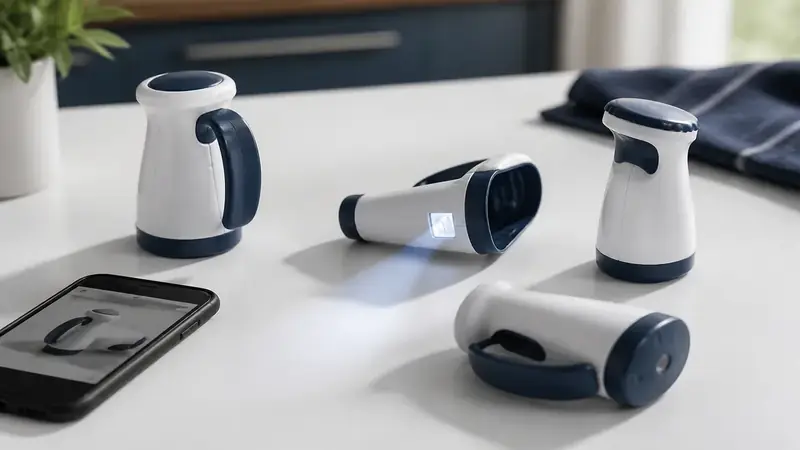
What does "what is this?" actually mean for an object?
It means you have a physical thing you could buy or sell and you want its name. That could be a kitchen gadget from a drawer, a lamp at a yard sale, or a gadget someone left at your place.
A good answer has layers: what kind of thing it is, who made it, which model, and then the practical stuff, like where it is sold and what it costs. This page covers all of those. Plants, insects, pills and people are out of scope; those need specialist tools.
Can you really identify an item from a picture?
Yes, when the item has features a visual search can match against known products. Shape, color, logo, printed text and proportions all count. Price ID compares your photo with visual matches and uses AI to name the product, including brand and model when recognizable.
You can take a fresh photo, pick a saved image or screenshot, or scan a barcode if the thing has one. You can also type a short text hint, such as "cordless drill" or "ceramic vase", to point the search the right way. A good item identifier does not need you to know the name first; that is the whole point.
What should you photograph first?
Start with the whole object on a plain surface, in daylight if you can. Shadows and clutter confuse matching more than people expect.
Then move in on the details that carry the most information:
- Any logo, brand name or stamped mark
- A label, sticker or engraved line with a model or part number
- The underside or back, where makers often put the real text
- Buttons, ports, clasps or hinges that set one model apart from another
- Packaging, if you still have it
One clear photo of the whole thing plus one of the label beats ten blurry ones. If the object is dangerous or unknown in a way that worries you (hot, pressurized, chemical), do not take it apart for a better angle.
Which clues matter most?
Text beats shape, and shape beats color. A printed model number can settle in a second what a silhouette cannot settle at all. This table shows how the clues rank.
| Clue | What it tells you | How much to trust it |
|---|---|---|
| Model or part number | The exact product | Very high |
| Brand name or logo | The maker and often the line | High |
| Material and build | Era, quality, category | Medium |
| Shape and size | The general type of item | Medium |
| Color alone | Very little | Low |
Color is the weakest clue because the same body is often made in many colors, and different products share one.
What does Price ID tell you after it names the item?
It goes past the name. For new items it shows matching listings with direct store links, compares prices across the online stores it finds, and points out the lowest price for your shopping region, with the price range and potential savings.
For used items it gives an estimated resale range, a typical price and example listings, based on current used-item asking prices on eBay. Buying prices and resale estimates are shown separately, so you do not mix up what a new one costs with what a worn one fetches.
If you are standing in a shop with the thing in your hand, you can ask yourself where can i find this cheaper, and the answer is a scan away. There are also 11 finders tuned to categories such as Electronics, Furniture & Home, Watches and Toys & Collectibles, plus a text hint box if the first result is off.
What is this app, and where do you get it?
If you are asking what is this app on an iPhone, it is Price ID, listed in the App Store as "What's It Worth: Price Scanner". It runs on iPhone and iPad with iOS 18 or later, and you can try it free with a limited number of scans each day.
The Deal Assistant, an AI chat in Pro, can go further: key features, pros and cons, cheaper alternatives, and whether the asking price looks fair.
Is there an object identifier app for Android?
Yes. On Google Play, Price ID is listed as "Price ID: What is This Worth?", and as an object identifier app it works the same way as on iPhone. Your first scan is free, then you get one free scan a day, with up to two more a day if you watch a short video. The free tier shows ads, and Pro removes the limits and ads.
One handy Android extra: you can share an image from another app straight into Price ID, no saving to the gallery first.
How do you find out what an item is worth?
Run the same photo and read the resale estimate. A how much is this worth scanner is only as good as the identification behind it, so get the name right first and the range follows.
Know what the number is. It comes from asking prices on current used listings, not completed sales, so it is an estimate and not a guaranteed sale price or an appraisal. Condition, model and included accessories move the value a lot. A boxed item with its cables is a different animal from the same thing loose in a bag.
Say you found a porcelain figure and want to know how much is this doll worth. Photograph the face, the marks on the back of the neck and the clothing tag, then compare the example listings. Old and unusual items may call for a printed antique price guide or a specialist as a second opinion.
When will a photo app struggle?
Plain, unbranded, handmade and very old items are the hard cases, and in those cases Price ID may return only similar matches. Confirm details and final cost with the retailer either way, since prices and availability vary.
- Handmade pieces: there is no catalog entry to match, so you get lookalikes at best.
- Very old items: a hundred-year-old tool may share its shape with dozens of makers.
- Plain objects: a gray plastic bracket with no text gives the search almost nothing.
- Damaged items: missing parts hide the features that identify them.
In those cases, take close-ups of any mark at all, add a text hint, and try a second angle. A barcode, if there is one, can skip the guesswork.
What do you do with a result once you have it?
That is a reminder you set, not automatic price tracking.
Before you buy, compare the listing against your object: same model, same size, same included parts. A near match is a sibling product more often than you would think. If you want the full buying side, the where-to-buy page on this site goes deeper.
Quick questions
Can I take a picture of something to identify what it is?
Yes, a clear photo is often enough to identify a common object. Shoot it from a few angles in good light, and include any logo, label or model number so the matching tool has more to work with.
What is this item called if it has no logo?
Price ID can still return likely matches from shape, material and details, but an unbranded item may only get similar matches. Adding a text hint and a photo of any stamped mark or label improves the odds.
Can I identify an object from a screenshot?
Yes, Price ID accepts a screenshot or any saved image as well as a live photo. Pick the one where the item is large and clear.
Can I scan a barcode to find out what a product is?
Yes, Price ID can scan a barcode or UPC and then show where to buy the product and how prices compare online. It works on items that carry a code, such as boxed goods.