


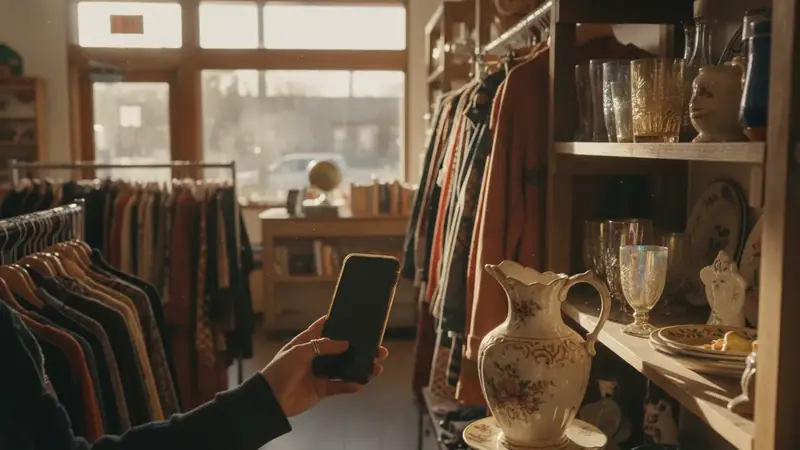
What a thrift app can tell you at the shelf
Three questions come up over and over in a secondhand shop. What is this? What does it cost new? What are used ones asking? Price ID answers all three from a photo, a saved image or a barcode scan.
New prices and used estimates show up separately, which matters. A new price tells you the ceiling; the used range tells you what a buyer might actually pay. The used range comes from current eBay asking prices, not completed sales, so it is an estimate and not a promise. Condition, model and missing accessories can move the number a lot.
One more limit: a plain or unbranded item may only get similar matches instead of an exact one. Adding a short text hint (a brand, a material, a model number you can read) helps focus the search.
At the thrift store rack or shelf
Speed matters here. You're holding a jacket or a blender, the cart is filling up, and nobody wants to stand in the aisle for ten minutes. Pick the finders that fit: Clothes & Outfits for racks, Electronics for gadgets, Furniture & Home for lamps and side tables, Toys & Collectibles for the bins.
If the item has a barcode, scan it. If it doesn't, take a photo of the front and one of any tag or stamp. Thrift store finds worth money are usually the ones with a readable brand or model, so photograph that part first.
Signal is a real problem in some shops. A basement thrift store with thick walls may have no Wi-Fi and one bar of data, and a lookup needs a connection. If you can't get online, take the photo anyway, move on, and check it when you're back outside. Saving finds into a collection keeps them in one place.
At a garage sale or yard sale table
Sellers at a yard sale usually set prices fast and low, and they often haggle. That makes a quick check even more useful, because you can walk away from a fair price or push back on a high one with something to point to.
Photograph the item on the table, then compare the sticker to the used range. If you plan to sell something yourself next weekend, the same lookup helps with garage sale pricing, since you can see what similar used items are asking before you write the stickers.
Most sales are outdoors and signal is fine. Early birds should check the cheap boxes of mixed items too; a single odd piece in a pile is often the one worth a lookup.
At an estate sale
Estate sales have more variety under one roof: furniture, jewelry, books, tools, kitchenware, sometimes art. Pick the finder that matches each category instead of using one search for everything.
Prices are often marked by a company, so the sticker may already be close to market. Your job is to spot what is marked too low, or what is a brand or model you wouldn't have recognized. Look at the maker's mark, the label on the underside, the model plate on the back.
Be careful with anything where authenticity decides the value, like fine jewelry or signed art. Price ID gives resale estimates from asking prices; it does not authenticate items or appraise them, so for something valuable you'd want a specialist.
At a flea market stall
Flea markets mix new, used, handmade and imported goods, so the first question is which one you're holding. Scan the barcode if there is one; if it's a loose item, photograph it from the front with the logo visible.
Flea market finds value depends heavily on condition and on whether the set is complete, so look for chips, missing parts and absent cables before you trust any range. Sellers expect a counteroffer, and having a used range on your phone makes it a calmer conversation.
Stalls in a covered hall can be dead zones for signal, just like a basement shop. Take your photos in the aisle and review them in the parking lot if you have to.
Online thrift and screenshots
Plenty of secondhand shopping happens in an app. If you see something in a listing or on social media, take a screenshot and open it in Price ID instead of retyping a description. On Android you can share an image straight from another app to Price ID, and on iPhone you can pick the screenshot from your photos.
Online thrifting is where the new price comparison helps most. A used item listed at close to the new price is not a bargain, and Price ID shows the lowest new price found for your region, so you can see that gap. Confirm the final cost with the retailer before you count on it.
Using it on iPhone and Android
On iPhone or iPad (iOS 18 or later), look for "What's It Worth: Price Scanner" in the App Store. It works as a thrift store scanner app: camera, saved image or barcode, with a limited number of free scans each day.
On Android, the Google Play name is "Price ID: What is This Worth?". As a thrifting app it gives you a first scan free, then one free scan a day, with up to two more a day if you watch a short video. The free tier shows ads. A Pro plan removes the limits and ads on both platforms.
Free scans run out, so on a big haul day use them on the items you're genuinely unsure about and skip the obvious ones.
Going deeper on thrift guides
Each situation above has its own guide on this site. For selling, there are pages on how to price items to sell and what sold items tend to go for. For buying, the guides on thrift store finds, pricing for yard sales and flea market finds go through categories one at a time.
If you want a general method for how to tell how much something is worth, the how-much-is-it-worth guide walks through it with any item, secondhand or new.
The one habit that helps everywhere
Photograph the maker's mark or the label before you do anything else. Brand and model are what turn a vague match into a useful one, and they're easy to lose once an item is in a bag.
Quick questions
Why does Gen Z like to thrift?
Gen Z shoppers tend to thrift for lower prices, a more sustainable way to buy clothes, and the chance to find unique pieces that fast fashion does not offer. Thrifting also fits the habit of reselling, since many young shoppers flip finds online for extra cash.
Can I get money from my old clothes?
Yes, you can sell old clothes through resale apps, online marketplaces, consignment shops, or local garage sales. Brand-name items in good condition usually bring the best prices, while plain or worn pieces may only fit a bulk donation or buyback.
Is there a better option than ThredUp?
It depends on what you want, since options include Poshmark, Depop, Mercari, eBay, and local consignment shops. Selling directly usually earns more per item than a clean-out bag service, but it takes more time for photos and listings.
What are the common complaints about ThredUp?
Common complaints include low payouts for clean-out bags, fees that cut into earnings, and items being rejected or recycled. Some buyers also mention that condition and sizing can vary from the listing description.
Which is the best online thrift store?
There is no single best, because the answer depends on what you buy. ThredUp and Poshmark are popular for clothing, eBay is strong for collectibles and electronics, and Etsy suits vintage goods.
What is the best thrift app for checking prices?
The best one is the one that tells you what an item is, what it costs new and what used ones list for. Price ID does all three from a photo, saved image or barcode scan, on iPhone and Android.