


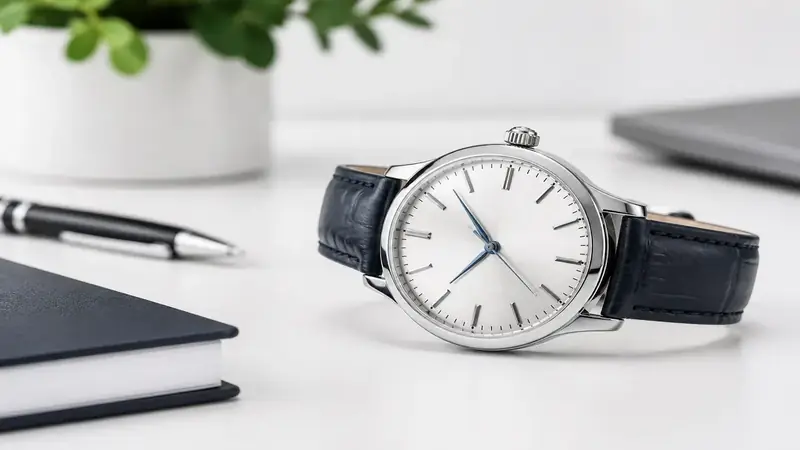
What identifies a watch model
A watch model is a specific brand, collection and reference: the exact version, beyond the name on the dial. Several versions of one collection can look almost identical, so you need the marks that separate them. Some are printed, some are engraved, and some are just shapes.
| Clue | Where to look | What it tells you |
|---|---|---|
| Reference number | Caseback, or between the lugs (often hidden under the strap or bracelet) | The exact version, which is the strongest single clue |
| Dial text | Face, under the logo and above 6 o'clock | Brand, collection name, depth rating, sometimes the movement type |
| Case size and shape | Round, square, tonneau or cushion; measure across the case | Which sibling version you have |
| Bezel | Ring around the crystal | Smooth, fluted, dive scale, tachymeter or 24-hour; separates sport from dress versions |
| Crown and pushers | Right side of the case | Crown guards, signed crown, chronograph buttons, screw-down or not |
| Movement type | Second hand sweep, caseback window, engraving | Automatic, manual or quartz; a smooth sweep versus a tick |
| Bracelet or strap | Center links, clasp, end links | Supporting evidence only, since straps get swapped |
The dial also hides smaller clues: hour-marker shape, numeral font, date window position and subdial count. Chronographs are often told apart by whether the subdials sit at 3, 6 and 9 or at 6, 9 and 12. A GMT has a fourth hand and usually a 24-hour scale.
Photos that give a good match
Put the watch on a plain surface near a window and turn off harsh overhead lights. Shoot the dial straight on so the markers, date window and text keep their true proportions. Glare on the crystal is the usual spoiler; tilt the watch or move yourself until it goes away.
- Take the dial first, then the side with the crown and pushers.
- Shoot the caseback so any engraving is readable.
- Lift the strap and photograph between the lugs if a number is stamped there.
- Add the clasp and bracelet end links.
- Skip filters; sharpening can invent detail on faded printing.
You can also type a short text hint, such as the name printed on the dial, to focus the search. A saved image or screenshot works too, which helps when you are checking a listing photo.
What Price ID returns for a watch
Price ID is made by ATN Marketing and has 11 finders tuned by category, including one for Watches. Pick it, add your photo, and the app looks for visual matches and names the brand and model when it can recognize them.
From there you get two separate things. For new watches, matching listings with direct store links, a comparison across available online stores, and the lowest price found for your shopping region. For used watches, an estimated resale range with a typical price and example listings.
If you are on iPhone, a watch identifier app is most useful when it is in your pocket at the shop counter or the estate sale table, and Price ID runs on iPhone and iPad with iOS 18 or later. On Android, the same job falls to a watch value app that can take a photo or a shared image from another app and return the resale range.
References that look alike on the wrist
Watches are a hard category for photo matching. Makers reuse one dial across several case sizes and metals, and a small difference in the bezel or bracelet can mean a different reference and a very different price. Plain or unbranded watches may only get similar matches, and prices, availability and matches vary, so confirm details and the final cost with the seller.
- Vintage pieces may have a redial, replaced hands or a swapped crystal that makes them look like another version.
- Fashion and quartz watches often reuse one design across several cheap references; the caseback code settles it.
- Smartwatches come in GPS, cellular and size variants; the model field in the settings screen is more reliable than the case photo.
- Counterfeits can copy a dial closely. A matching photo cannot tell a genuine watch from a good copy.
How much is a used watch worth?
People often type how much is my rolex worth, or the same question for any brand, and the honest answer depends on the exact reference and the condition. Price ID's resale range is built from current used-item asking prices on eBay, not completed sales, so it is an estimate and not a guaranteed sale price. It is also not a professional appraisal.
Several things move a used watch up or down:
- Box and papers: a full set usually sells for more than the watch alone.
- Service history: receipts from a service center help a buyer trust the movement.
- Condition: polishing, scratches on the crystal, bezel wear and stretched bracelets all count.
- Originality: replaced dials, hands or bezels change how the watch is described and priced.
- Accessories: extra links, spare straps and the original warranty card.
If you are weighing how much is it worth to sell, compare the typical price with the example listings and look at which ones include the box. For a rare or high-value piece, a jewelry appraisal from a qualified specialist is the right next step before you set a price. If you want to learn about an online valuation option for general items, an appraisal app can give a quick range, but a watchmaker still has to open the case.
Paperwork and condition checks for a watch deal
Before you pay, compare the reference number in the seller's photos with the one in your match. Ask for a clear shot of the caseback and the clasp, and ask whether the dial, bezel and crown are original. A stock image cannot show you the condition of the watch you will receive.
Selling is the mirror image. Collect the box, papers and service receipts, photograph the reference number clearly, and write the listing with the exact model instead of words like rare or vintage. Save the find in a collection in Price ID and set a reminder to re-check the price before you list.
For an expensive or vintage watch, have a watchmaker check the movement and authenticity before the return period ends. A photo can narrow the model and the price range; it cannot hear the movement.
Quick questions
How to check if a watch is original?
Compare the reference number and serial number on the watch with the maker's records, and check the dial printing, movement, weight and case finishing against a known genuine example. A watchmaker or authorized dealer can open the caseback and confirm the movement, which a photo cannot do.
What is the 3 watch rule?
The 3 watch rule is an informal idea that a well-rounded collection needs only three watches, usually a dress watch, a sports or tool watch and a casual everyday watch. It is a guideline, not a formal standard, and collectors apply it in different ways.
What watch is this if there is no name on the dial?
Look at the caseback, the space between the lugs and the movement for a reference number, serial number or maker's mark. Case shape, crown, bezel, hands and bracelet style also help narrow down the brand, and some brands do leave the dial unsigned.
Where is the reference number on a watch?
It is usually engraved on the caseback or stamped on the case between the lugs, where the strap or bracelet covers it. Remove or lift the strap and photograph the number for a better search in Price ID.
How much is this watch worth used?
It depends on the exact reference, condition, and whether the box and papers are included. Price ID shows an estimated resale range based on current eBay asking prices, with a typical price and example listings.
Can a photo tell me if a watch is real?
No. Price ID can match a photo to a model, but it does not authenticate watches, and a convincing copy can match too. A qualified watchmaker needs to inspect the movement and case.