


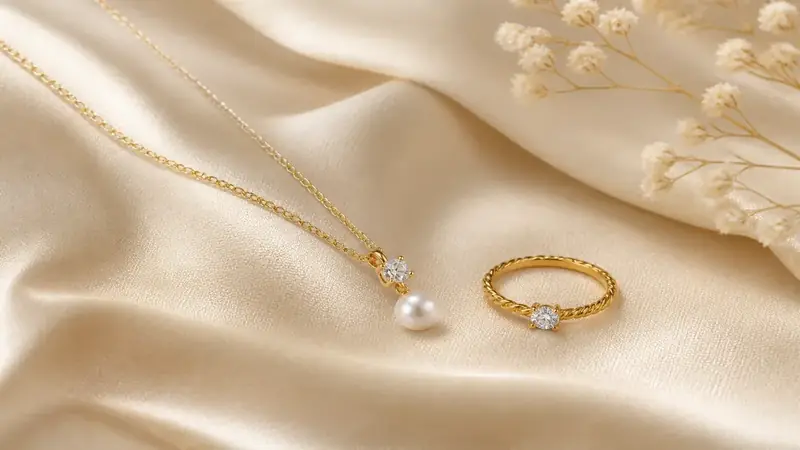
What actually identifies a ring, necklace or bracelet
A jewelry identifier, whether a person or an app, works from a short list of physical clues. Some are stamped into the metal; others are about shape. A stamp is a purity or maker mark, and it is the single most useful thing to photograph because it narrows a search faster than the front view ever will.
| Clue | Where to look | What it tells you |
|---|---|---|
| 10K, 14K, 18K, 585, 750 | Inside the band, near the clasp, on the bail | Gold purity the maker claims (585 is 14K, 750 is 18K) |
| 925 or sterling | Inside the band, clasp tag, earring post | Sterling silver |
| PT950, PLAT | Inside the band | Platinum |
| Maker's mark or cartouche | Next to the purity stamp, on the clasp or back | Who made or sold it |
| Setting type | Top and side view | Solitaire, halo, bezel, channel, pave, cluster |
| Stone shape | Top view | Round, oval, princess, emerald, pear, cushion |
| Chain type | Links laid flat, plus the clasp | Curb, rope, box, cable, snake |
A stamp is a claim, not proof. Fake stamps exist, and plated pieces carry marks too, so a 14K stamp tells you what the piece says about itself.
How to photograph jewelry for a good match
Daylight from a window, a plain matte background, no flash. Flash turns facets and polished metal into white glare and hides the details a match depends on.
- Shoot the whole piece first, then the face, then the side profile so the setting is visible.
- Take the stamp close up, straight on, with the tap-to-focus box on the characters. Digital zoom blurs them.
- For a ring, photograph the inside of the band; for a necklace, the clasp and any tag.
- Lay chains flat so the link pattern shows.
- Skip filters; they shift the color of yellow, white and rose metal.
You can also add a short text hint in Price ID, such as "14K gold halo ring", to focus the search on what you already read off the piece.
What Price ID returns for jewelry
Price ID has a finder tuned for jewelry. You can take a photo, pick a saved image or screenshot, or share one in from another app on Android. It looks for visual matches and names the brand or style when it can recognize it.
The results are split on purpose. Buying prices show what matching new pieces cost at online stores for your region, with direct store links and a lowest price found. The resale side is separate: an estimated used range with a typical price and example listings, based on current used asking prices on eBay. Those are asking prices, not completed sales, so a ring may sell for less than the range suggests.
If you're hunting for a lookalike (find this necklace, find this ring in a similar style for less), the dupe finder shows comparable designs from other brands.
Getting Price ID on iPhone or iPad means searching its App Store name, What's It Worth: Price Scanner. Once it's installed, this jewelry identifier app does the matching from any photo you pick, which is handy when you're sorting a drawer of inherited pieces. On the iOS side, a limited number of free scans come daily.
What a photo cannot tell you
Be clear about this before you quote any number. No app can test metal purity, grade a diamond, or say whether a stone is natural, lab-grown or a simulant. A cubic zirconia and a diamond can look the same in a photo, and so can moissanite. Color, clarity, cut and carat weight are measured with instruments and a loupe, not a phone camera.
A photo also cannot show wear under the stones, repairs, a swapped center stone, or whether a stamp is genuine. Plain, unbranded or handmade pieces often get only similar matches, because there is no model to find.
Plain bands, simple chains and other near-matches
Jewelry is the category where close is common. Mass-market rings come in many sizes and metals, and one design may be made in 10K, 14K and sterling at very different prices. A photo cannot see which version you hold, so read your stamp and compare against the match with the same one.
- Unsigned vintage pieces match on style, not on a maker.
- Cast reproductions copy the front of an antique but simplify the back.
- Costume pieces are priced by signature and condition, not by material.
- Gold weight changes everything; a heavy chain and a hollow one can look identical.
Android, and the question of a free appraisal
People search for a certified number from a free tool. On Android, Price ID is a free jewelry appraisal app only in the loose sense: the first scan is free, then one free scan a day, with up to two more by watching a short video, and the free tier shows ads. It gives a market estimate, not a formal appraisal. Its Google Play name is Price ID: What is This Worth?
Check these before you buy or sell a ring
- Read the stamp with a loupe and compare it to the listing; a missing stamp is a question to ask.
- Confirm the metal and weight in writing if you're buying; for selling, know that scrap and resale values differ.
- Ask whether the stone is natural, lab-grown or simulated, and whether there's a lab report.
- Look at condition: worn prongs, thin shanks, resizing marks.
- Check the return policy and the final delivered cost with the seller, since prices and availability vary.
If the piece is a gift or a find, save it into a collection and set a reminder to re-check the price later. Price ID has reminders for that, not automatic alerts.
The same method works across the site. If it's a watch, the question is what is this watch worth; for a purse, people ask where can i buy this bag, and there are separate guides for both. Antiques have their own page too, and a free antique appraisal app question gets the same honest answer: an estimate is not an appraisal.
When you need a jeweler's appraisal
Get a professional appraisal for insurance, an estate, a divorce, a high-value sale or any piece with a significant stone. A jeweler or gemologist can test the metal, grade the stone and write a document an insurer will accept. Knowing how to get something appraised is mostly knowing which kind you need: a replacement-value appraisal for insurance reads very differently from a quick resale opinion.
Use Price ID first to learn what you have and what similar pieces are asking. Then spend money on the appraisal only if the piece is worth it.
Quick questions
How can I find the value of my ring?
Start with the metal stamp, the stone type and size, and any maker's mark, then compare with similar rings listed for sale. For a firm number, especially for insurance or an estate, a certified jeweler or gemologist can test the metal and grade the stones in person.
How to tell costume jewelry from real?
Look for a karat or metal stamp such as 14K, 585, 750, 925 or PT950, since costume pieces often have none or carry marks like GP or plated. Real gold does not tarnish green, and a magnet should not pull on it, but only a jeweler's acid or electronic test confirms purity.
Are diamonds worth more now than 10 years ago?
Not necessarily. Natural diamond prices have shifted over the years, and lab-grown diamonds have become much cheaper, which pulls down prices for many stones. Resale value of a used diamond ring is usually well below its original retail price.
Can you take a picture of a ring and find it online?
Yes, a clear photo can surface similar rings through visual search, especially for branded or distinctive designs. Plain bands and simple solitaires tend to return only look-alikes, so adding details like the stamp or stone shape helps narrow results.
What do 585, 750 and 925 mean on jewelry?
They are fineness marks showing metal purity in parts per thousand. 585 is 14K gold, 750 is 18K gold, and 925 is sterling silver.
Where is the hallmark on a ring?
The hallmark is usually stamped on the inside of the band, often near the bottom opposite the stone. On other pieces, look at the clasp, the tag next to it, or the back of a pendant, and use a loupe or a magnifier because the marks are tiny.