


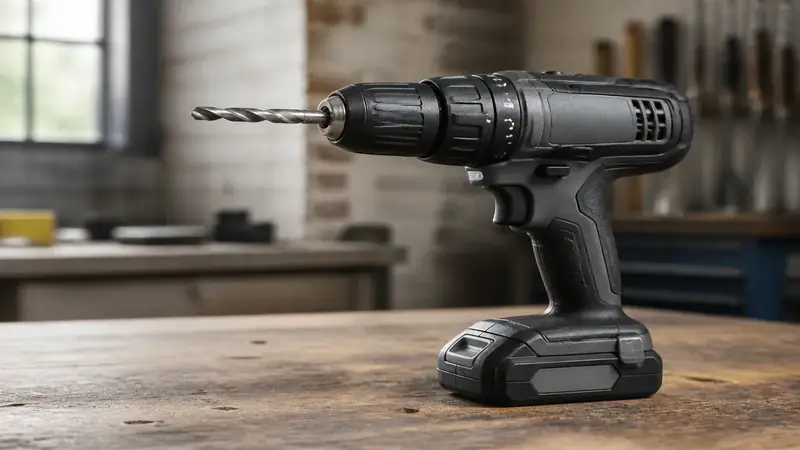
What actually identifies a tool
Most tools carry the answer somewhere on the body. The trick is knowing where, because the housing color alone tells you very little; a brand's yellow or red can span many generations.
| Clue | Where to look | What it tells you |
|---|---|---|
| Model number | Nameplate or sticker on the housing, often near the base or battery mount | The exact model, and usually the revision |
| Battery platform and voltage | Printed on the battery and the tool foot | Which batteries fit, and whether you are looking at a bare tool or a kit |
| Chuck size | Stamped on the chuck collar, such as a fractional or millimeter figure | The largest bit shank it holds |
| Blade or bit type | The working end: tooth pattern, shank shape, arbor hole | What the tool or accessory is meant to cut or drive |
| Maker's stamp | Forged or etched on the jaw, blade tang or handle of hand tools | The maker, and sometimes the size or steel grade |
Knives work the same way. Look for the stamp on the blade near the handle (the ricasso), the maker's mark, and any model name etched on the spine or tang.
How to photograph a tool for a good match
Start with the whole tool on a plain surface, lit from the side. Then take a second photo of the nameplate close enough that you can read it. If the tool is corded, unplug it; if it is cordless, pop the battery out first.
Shallow stamps on hand tools show best under raking light, so tilt a lamp low across the metal. For a drill, shoot the chuck. For a saw blade or router bit, lay it flat and include the arbor hole. Add a short text hint (say, the word "impact driver") when the shape is ambiguous.
You can also pick a saved image or a screenshot of a listing. Any photo-based tool works from what the picture shows, so a blurry label gives it little to read.
What Price ID returns for a tool
You get matching listings with direct store links, a comparison across available online stores, and the lowest price found for your shopping region. If you have been typing "find this tool" into a search box and getting nothing, this is the photo version of that.
New buying prices and used resale estimates appear separately, which matters for tools because a bare-tool price and a kit price are different things. The resale range comes from current used asking prices on eBay, with a typical price and example listings. If you are standing in a garage and wondering what can i sell this for, that range is your first answer. It is an estimate from asking prices, not completed sales, and not an appraisal.
On iPhone, search for the tool identifier app under its App Store name, What's It Worth: Price Scanner, and scan from the camera or a saved image.
How much is this tool or knife worth?
Used value depends on things a photo only partly shows. For power tools, the battery often swings the number: two identical drills can sit far apart if one has a healthy battery and charger and the other is bare. Condition, model, and included accessories all move the price.
For knives, the maker, the model, the blade steel and the condition of the edge and handle matter. A well-known maker's discontinued model can ask more than a current one; a chipped or heavily sharpened blade asks less. Compare the example listings Price ID shows against your own item, and look past the typical figure.
Tool models that differ by one letter
Plain, unbranded or worn tools may only get similar matches. A brand often reuses a housing across several models, so a drill and its hammer-drill sibling can look alike. Old hand tools with a worn stamp are harder still.
When that happens, use the model number you read off the nameplate as the text hint and scan again. Search the accessory separately from the tool it came with. A blade that fits an arbor is not automatically rated for that tool's speed, so check the manual for the exact model.
Price ID is also a handy way to find item by picture when you only have a shape and no name, then confirm the details yourself.
Check before you buy or sell
- Does the model number on the plate match the listing, including any suffix?
- Is it a bare tool or a kit, and how many batteries come with it?
- Do the battery platform and voltage match the batteries you already own?
- Are the guards, cord, chuck and blade intact?
- Is the price you were shown still current at the retailer, including shipping?
Prices, availability and matches vary, so confirm details and the final cost with the seller or store. At a thrift shop, a thrift app check on a tool takes a moment and can tell you whether a tagged price is low or high before you reach the register.
Using Price ID on Android
On Android, Price ID is listed as Price ID: What is This Worth? The first scan is free, then you get one free scan a day, with up to two more a day if you watch a short video. Because it also scans barcodes and screenshots, it works as a general scanner product app for tools in a store aisle as well as ones in your garage. Pro removes the limits and ads.
If you shop for tools on both phones, the same product scanner app habit applies: photo the nameplate first.
Quick questions
Is there an app that identifies tools?
Yes, several apps can identify a tool from a photo by matching its shape, brand markings and label against known products. Price ID is one of them, and results are strongest when the brand name or model number is visible in the picture.
How do you identify your tools?
Start with the brand name and the model number stamped or printed on the nameplate, housing label or blade. Then note the voltage, battery platform, chuck size or blade type, since these narrow down which version of a tool you have.
What is this tool used for?
The shape of the working end usually tells you the job. A tool with a spinning chuck drills or drives, a flat toothed blade cuts, and a jaw with an adjustable opening grips or turns fasteners. If you know the name or model, the manufacturer's manual lists the intended uses.
What are 5 examples of tools?
Five common examples are a hammer, a screwdriver, a cordless drill, a tape measure and an adjustable wrench. Most workshops also have pliers, a saw and a level.
Can you give me a list of tools and their names?
Hand tools include hammers, screwdrivers, pliers, wrenches, chisels and hand saws. Power tools include drills, circular saws, jigsaws, angle grinders, sanders and routers, and measuring tools include tape measures, squares and levels.
Why do two tools that look the same have different prices?
Small differences such as a brushless motor, a different battery platform or whether the battery and charger are included can change a tool's value a lot. Model numbers that differ by a single letter often mark these differences, and condition and wear also affect the price.