


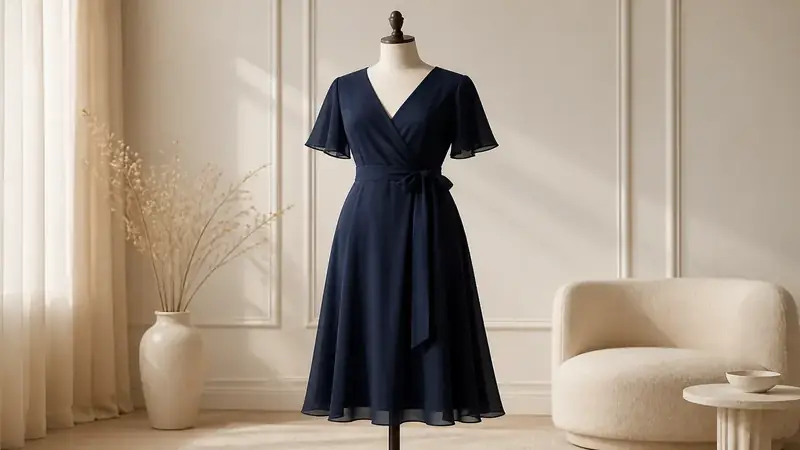
What actually identifies a dress
A dress has no model number you can read from across the room, so you identify it the way a salesperson would: by its parts. Silhouette is the overall outline. Everything else (neckline, sleeve, waist, hem, fabric, trim) narrows it down. A good description sounds like emerald satin cowl-neck midi slip dress, not green formal dress.
| Clue | Where to look | What it tells you |
|---|---|---|
| Silhouette | The full outline from shoulder to hem | A-line, sheath, slip, wrap, fit-and-flare, empire or mermaid |
| Neckline | The edge around the neck and shoulders | V-neck, square, scoop, sweetheart, halter, cowl, off-shoulder |
| Sleeve | Armhole, volume and cuff | Cap, puff, flutter, bell, bishop, long or none |
| Waist | Seam, belt or gathering | Natural, empire, drop, tie waist, or no defined waist |
| Hem length | Where the skirt ends against the body | Mini, knee, midi, maxi, floor-length, or high-low |
| Fabric and print | Sheen, drape, texture, repeat pattern | Satin, chiffon, velvet, jersey, lace, floral, gingham |
| Small details | Bodice, skirt, back | Ruching, smocking, slit, pleats, tiers, buttons, tie waist |
| Sewn-in label | Inside the neck or side seam | Brand, size, sometimes a style number and fiber content |
The sewn-in label is the only clue on that list that can name the exact dress. The rest get you to a close family of dresses.
Silhouettes that get mixed up
Most wrong matches come from confusing two outlines that look alike in a photo.
- A-line narrows at the upper body and widens toward the hem. Fit-and-flare has a clearly fitted bodice, then a defined waist, then a fuller skirt.
- A sheath follows the body with a fairly straight skirt. A slip dress is also narrow, but it is cut on the bias in a fluid fabric with thin straps, so it drapes instead of holding a shape.
- A wrap dress has overlapping fronts that tie or fasten at the side. A fixed surplice bodice only looks like a wrap.
- Empire puts the seam under the bust; drop-waist moves it toward the hips.
If a tie waist is the feature you remember, say so. It is one of the details that separates two otherwise identical midi dresses.
How to photograph or crop a dress for a good match
Start with one clean full-length shot, shoulder to hem, straight on. Hang the dress or lay it flat without pulling the fabric out of shape. If you're copying a dress you saw on someone, crop out the heels, the background and any text so the dress fills the frame.
Then take a close shot of whatever makes this dress different: the neckline, the print, the ruching, the back. Satin, sequins and velvet need angled daylight; flat flash turns highlights white and hides the seams. Skip filters, because a filter changes the color you're trying to match.
If the dress has a sewn-in label, photograph that too. A style number is the shortest route to the exact dress.
Found the dress in a post? You can shop the look from a post by screenshotting it and cropping to the dress. Posing, camera height and heels can change where a hem seems to fall, so don't trust the apparent length too much.
Price ID also lets you add a short text hint, such as wrap or satin, to point the search at the feature you care about.
What Price ID returns when you search a dress
You can use a photo, a screenshot, or a saved image. Price ID reads the dress with visual matching and AI, and names the brand and model when it can recognize them. Its Clothes & Outfits finder is built for this, so you can find clothes by picture without guessing the right search words first.
The results come in three kinds:
- Exact listings: when the dress is recognized, you get matching listings with direct store links.
- Similar dresses: the same silhouette, neckline and print from other sellers, useful when the original is sold out or unbranded.
- Similar for less: lookalike dresses from other brands at lower prices.
Similar for less is a clothing dupe finder. If a designer wrap dress is far beyond your budget, it shows dresses with the same cut and print from other brands, so you can compare cost against how close the match really is.
For new dresses you see current buying prices across available online stores, with the lowest price found for your shopping region and the potential savings. For a used dress, Price ID shows a resale estimate based on current used-item asking prices on eBay, with a typical price and example listings. Buying prices and resale estimates are shown separately, so you never mix them up.
Using Price ID on iPhone and Android
On iPhone or iPad (iOS 18 or later), Price ID is a shop by image app: open it, take a photo of the dress or pick a screenshot from your camera roll, and the search runs from there. The App Store name is What's It Worth: Price Scanner.
On Android, the Google Play name is Price ID: What is This Worth?, and you can share an image from another app straight to it. That makes Price ID a handy outfit finder app when you spot a dress while scrolling and don't want to save the picture first.
Keep the result in a collection and set a reminder to check the price later. Pick your shopping region and currency so the stores shown actually ship to you.
Wedding and occasion dresses
If you want a wedding dress finder, the same logic holds, with extra attention to construction. Bridal and formal dresses are described by details that are easy to see in a photo: ball gown, mermaid or trumpet skirt, a train, a corset back, lace appliques, illusion sleeves, a sweetheart neckline. Photograph the back and the train; for many gowns, that is where the design lives.
Occasion words are labels, not physical traits. A black midi can be office wear, a cocktail dress or a casual piece, depending on fabric and styling. White does not make a dress bridal, and sequins do not make it black tie. Describe the structure first and add prom, wedding guest or cocktail afterward.
For guests, similar dresses and Similar for less are often more useful than an exact match. A custom or made-to-order gown may only come back as similar styles, and that is normal.
Dresses that only come back as lookalikes
Dresses are where close-but-not-exact happens most. Plain or unbranded dresses may only get similar matches, and a fast-fashion dress is often copied in near-identical versions under different names. Confirm the model and the delivered total with the retailer before you commit.
Expect a near match in these cases:
- A solid-color dress with no distinctive trim, where many brands share the same cut.
- A dress seen only on a person in motion, with the hem or waist hidden.
- A print that is repeated and recolored across several seasons.
- A vintage or handmade piece with no label.
If the first result is off, crop tighter on the one feature that matters, or add a text hint, and search again.
What to check before you buy or resell the dress
- Fabric: a photo suggests satin or chiffon but cannot prove it. Read the listed composition or the care label.
- Color and length: retailer photos are often edited, and the listed length may be for a different size.
- Measurements: compare the bust, waist and hem numbers instead of trusting a size letter, since sizing varies between brands.
- Lining and opacity: light colors and thin fabrics can be see-through.
- Return policy: especially for wedding dresses, where alterations may void returns.
- Resale: the estimate comes from asking prices, not completed sales, and condition, size and included pieces such as a belt or slip change what a used dress is worth.
Price ID does not authenticate a dress or appraise it. It gets you to the likely product and the price range; the final check is yours.
Quick questions
Is there an app to identify dresses?
Yes, several shopping apps let you upload a photo or screenshot of a dress and return matching or similar listings. Price ID is one example, and it works from a photo, a saved image or a screenshot on iPhone and Android.
How to find a dress from a photo on iPhone?
Take a clear photo or screenshot of the dress, then run it through a visual search tool such as Google Lens in the Google app or a shopping app. Crop out the background and other people so the search focuses on the dress itself.
Is there a way to find a dress from a picture?
Yes, reverse image search and visual shopping tools compare the shapes, fabric and print in your picture against product listings. A sharp, full-length image with good lighting gives the best chance of an exact match.
Where is this dress from AI?
AI image tools can guess the brand or store by matching silhouette, fabric and print to product photos, but the result is a best guess. Always check the listing details, such as the neckline, sleeve and hem, before trusting that it is the same dress.
Where can I buy this dress if I only have a screenshot?
Crop the screenshot to the dress and search it in Price ID to see matching listings with direct store links and current prices from online stores. On Android you can also share the image to Price ID from another app.
What dress is this if it has no label?
Without a label, Price ID can still match the dress by shape, neckline, print and fabric, but plain or unbranded dresses may only return similar styles. Describing the silhouette in a text hint can help.